Architecture
View SourceOverview
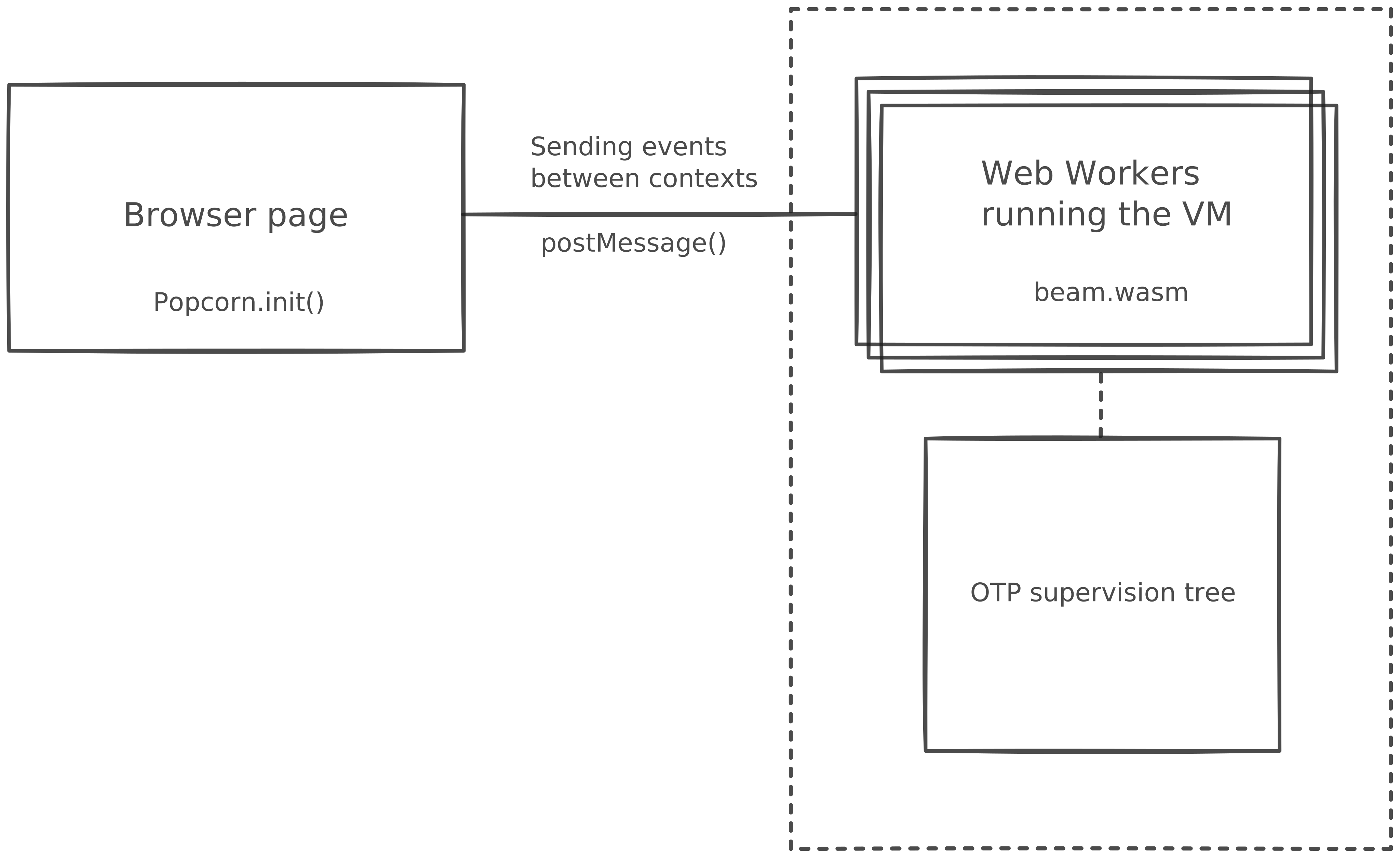
Popcorn works by:
- Compiling OTP/BEAM to Wasm, using Emscripten. The VM itself is patched to either adjust the VM code to work in a browser context or remove features unsupported there.
- Running the VM in multiple Web Worker threads which communicate with the JavaScript API using
postMessage(). This gives us isolation: a Web Worker crash doesn't affect the main page. - Providing some API surface to hook the VM to JavaScript. For example, sending messages to processes works through the
:wasmmodule which exposes a JavaScript API to Emscripten, and at the same time, exposes an Erlang API for Popcorn modules to use. The:wasmmodule is a wrapper for a NIF (which is written in C). - Including the batteries: packaging applications into tarballs, reducing their size, exposing adapters for low-level APIs (Req adapter, terminal API), and making sure that this C-JS-Erlang-Elixir-Wasm amalgamation works well.
Packaging
While Popcorn keeps the BEAM bytecode format, it still post-processes .beam files before they are executed in the browser. Most notably, it strips unused chunks and can tree-shake parts of the code that are unreachable.
We also pack the apps into tarballs to ship a few bigger files instead of a lot of smaller ones. This allows us to introspect the files themselves and build a metadata file about them. This is important for selecting the correct VM variant (Popcorn ships crypto-less and crypto-full VM versions) and detecting incompatibilities.
Popcorn provides the mix popcorn.cook task that does that and Vite/esbuild/Rollup plugins that do the same.
Initialization
Booting the VM works roughly as follows:
- Request all needed assets (
.wasm, tarballs, Popcorn JavaScript files). - Register handlers for events coming from the VM in the Popcorn class instance. Start the timers which will fire if the booting process takes too long.
- Create the main Web Worker which loads the Emscripten module of the VM. This creates new Web Workers (e.g. for schedulers) in turn.
- Run Erlang's boot file, which loads core modules and starts the typical OTP
initprocess. This starts applications and their supervision trees. - After all apps (including the user's) are up, finish the initialization from the JavaScript side, resolve the
Popcorn.init()promise and give control back to the user.
JavaScript and the VM aren't synchronized in execution and you need explicit messages to wait on each other.
Sending messages
The :wasm module mentioned before is mostly responsible for serialization of messages between JavaScript and Elixir. If the messages are sent from cast() or call(), we route them through Popcorn.Proxy, which forwards the messages to their destination and handles timeouts and non-existent target processes. By default, Popcorn includes only one Proxy in its supervision tree but it's possible to create more.
All messages (GenServer or not) still always pass through a single :wasm module.
Handles
Popcorn introduces TrackedValue handles for JavaScript values, allowing them to be passed to Elixir. JavaScript keeps the values in a map, and entries in it are keyed by handles (they're treated specially during serialization). We also allow attaching a cleanup function to the TrackedValue which is run after the VM loses the handle (garbage collected). The cleanup runs asynchronously.
We also have Pid values which are terms accessible from JavaScript. They're used for specifying the target process in send(), call(), and cast(). See "Sharing values across languages" for the other supported value types.